

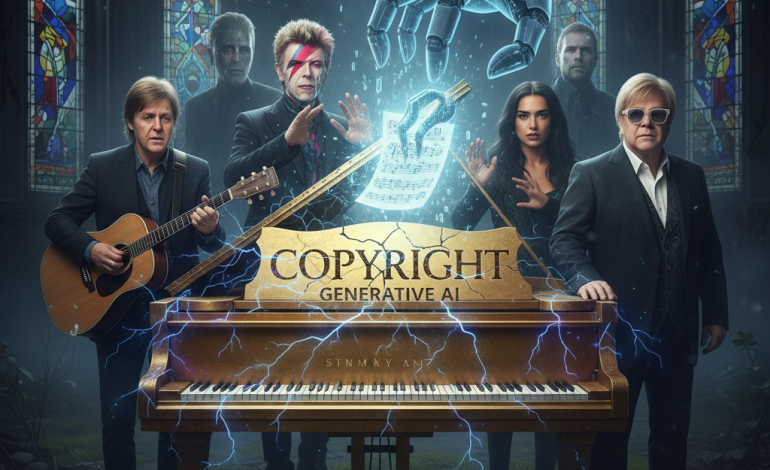
When the likes of Paul McCartney, Kate Bush, Annie Lennox, and Elton John put their names to the same cause, it signals something larger than another industry petition. Alongside them, hundreds of songwriters, producers, and independent musicians have come together in voicing their fears through an open letter addressed to Prime Minister Keir Starmer, urging his government to take a stand against proposals that would allow Artificial Intelligence (AI) systems to train on copyrighted works without the consent of the artists. The letter frames the issue starkly: “Our life’s work is not free fuel for AI.”
This collective call to action has been strategically timed to coincide with the UK-US tech pact and the second state visit of Donald Trump, with talks expected to brush over the thornier aspects of copyright protections. Joining Trump in his entourage are technology heavyweights from Nvidia’s Jensen Huang to OpenAI’s Sam Altman. With Labour’s AI Bill yet to be materialised, the UK has become reliant on voluntary codes and arbitrary advice from external bodies, inadvertently stoking a sense of fear due to the lack of available safeguards across the creative industries.
In their letter, the artists warn that AI companies have been “harvesting songs, recordings, and lyrics to create synthetic outputs that compete with original works without credit, permission, or payments.” For veterans like McCartney, whose catalogue spans decades, and for independent musicians, this signals an existential crisis of originality and leaves artists to wage a losing battle against the rising capabilities of Generative AI models. Without safeguards, the fear is that a whole generation of songwriters could see their economic bases being eroded, just as they begin to establish themselves.
This is not the first time musicians have challenged the government over technology. The last decade was characterised by fights over streaming royalties, Spotify’s opaque algorithms, and the ever-persistent ticket resale scandals. The artist’s expectations of the Labour government are heightened, given Starmer’s past support for a £1 ticket levy, a proposal designed to reinvest in grassroots music venues. This prior stance on protecting the economic infrastructure of the industry suggests a precedent for his willingness to intervene on behalf of artists. Yet, the stakes are higher this time as Starmer finds himself at a crossroads: whether to position the UK as a global leader in AI innovation or bring the unpleasant side of regulation and copyrights to the table. To thread the needle, it will require more than platitudes as artists continue to demand legal clarity towards bringing in safeguards in a digital economy that has too often exploited them.
It is not just the UK that is facing this looming reckoning. In the US, Universal Music Group has sued the Amazon-backed AI company Anthopic over using copyrighted lyrics in training datasets. The UK’s AI-copyright conundrum debate is riddled with complexities, and its decisions in the coming months will create ripples far beyond its borders. For now, the artist’s chorus rings clear and lies on Starmer’s desk: Will the UK defend those who have shaped the country as a cultural powerhouse, or would it allow itself to be drowned out by machine-made echoes?

