

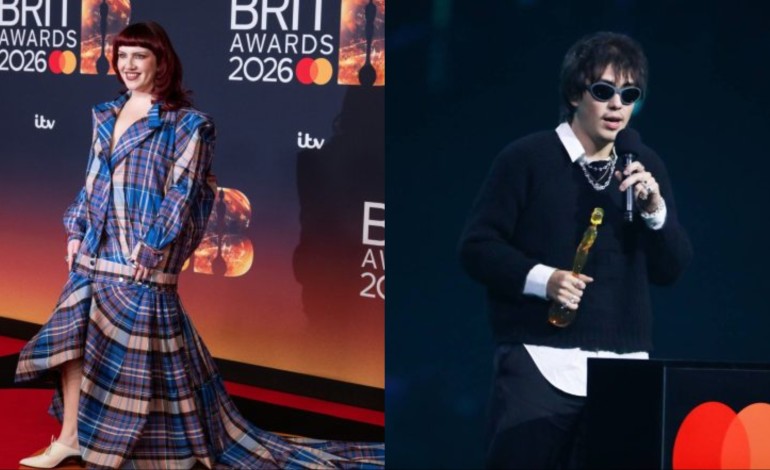
Whilst history was being made at this year’s BRIT awards from Olivia Dean’s four-win domination to a memorable tribute to Ozzy Osbourne, other artists were expressing political concerns on the red carpet regarding the rise of right wing forces. Several BRIT winning artists such as Wolf Alice and Geese were censored during the live broadcast of the BRITs for sharing political statements.
The censorship of these statements has lead to concerns from artists about how musicians should feel empowered to be political. Indie-underdog CMAT, nominated for International Artist Of The Year, stated she was “not a big fan of anyone trying to argue that art is not a political place” and that “everything is politics. But more than ever, art is politics because you don’t get to make art in a fascist state. Fascism is on the rise in every single country in the world.”
She had previously criticised Berlin film Festival jury’s Wim Wenders, who stated that cinema should “stay out of politics”. The Irish singer shunned Wenders’ statement as she commented on “fascism rearing its ugly head in Ireland, its showing its ugly head all over the UK and don’t even get me started on America.”
“It’s cowardice,” She said in interview with The Guardian, “And I think it is showing that these people are extremely separate from how normal people live their everyday lives. You know, they’ve become successful artists. Become successful musicians, film-makers, and so they have wiped their hands clean of having to do anything with the working classes or having to do anything with anyone who is oppressed in any nation because they have the luxury of doing that. And I don’t think that’s fair.”
Theo Ellis, drummer of UK Group of The Year BRIT winners Wolf Alice, said he felt it was left to musicians to speak out on current political affairs because of the lack of coverage in traditional media.
“[Musicians] have the power to expose people to information they might not have got somewhere else,” he said.
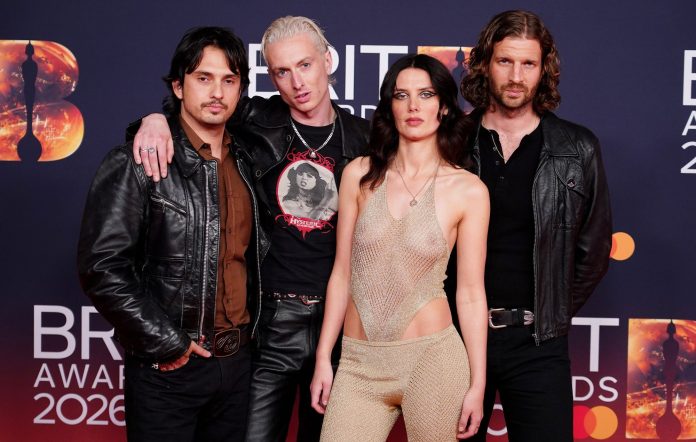
UK Group of The Year 2026 BRIT winners Wolf Alice on the red carpet. CREDIT: Ian West/PA Images via Getty Image
Alternative/rock category nominees Wet Leg also voiced political concerns on the red carpet. “I think that to be apolitical is political,” stated frontwoman Rhian Teasdale. The group’s guitarist Joshua Omead Mobaraki also commented on the rise of Reform UK, saying he “[doesn’t] want UK Reform to win any seats.”
Hip-hop king of the UK scene Loyle Carner shared similar concerns about UK Reform. “It’s scary times we’re living in. But it’s such low-hanging fruit. I feel, in my circle, or the echo chamber I exist in, to say that I hate Nigel Farage … it’s not hard to say that.”
Artist of the year runner-up Rebecca Taylor AKA Self Esteem expressed sympathy with other musicians who felt their political statements were being censored. “I just can’t not say what I think because it’s too frightening. I’m genuinely terrified that we’re going into a dark place, darker than where we are already.”
Alongside the nominees, comedian Jack Whitehall who was this year’s award presenter had his comments axed from the broadcast, notably a joke about Peter Mandelson. Whitehall joked that he spotted Mandelson sitting amongst a ‘politicians table’. Former Labour grandee Mandelson was arrested last week on suspicion of misconduct in public office, with investigation into allegations that he leaked sensitive information to sex-offender Jeffrey Epstein.
Geese-drummer Max Bassin also had part of his speech censored from broadcasting as he accepted the award for International Group Of The Year. He made it as far as, “What’s up the Brits! I just want to say-” before the remaining speech was censored.
“Free Palestine, f*ck ICE, R.I.P. Mani, let’s go Geese,” he stated.
Once a seemingly neutral ground for politics, music and culture intersecting, the BRITs have taken a much stricter approach to political statements. In previous years, several political moments were captured on the award’s stage. 1995’s awards saw R&B royalty Prince perform a silent protest against his record label dispute, appearing onstage with “SLAVE” written on his cheek. Stormzy also utilised the stage for political input during his 2018 performance where he spoke out on the 2017 Grenfell Tower Fire, confronting Theresa May as he rapped “Where’s that money for Grenfell? You criminals.”
The sensitivity regarding political statements has been amplified across many awards ceremonies this year. In the BAFTAs last week, My Father’s Shadow director Akinola Davies announced “Free Palestine” during his acceptance speech for Best Debut by A British Writer, Director or Producer. This remark was edited out of the BBC broadcast.
In the Grammy awards ceremony last month, several artists including Hailey and Justin Bieber and Joni Mitchell were seen wearing pin badges that read “ICE out”. The censorship controversy is particularly prevalent due to what producers are ruling out as acceptable versus what is unacceptable. At the BAFTAs, John Davidson used a racial slur onstage that was didn’t get censored during broadcasting. An official apology was made owed to the activist’s Tourette’s Syndrome, but many have called the outburst “unacceptable”. The incident has sparked conversations about political censorship seeming unjustified comparatively.
No official announcements about the censorships of these statements has been made by the BRIT awards.

